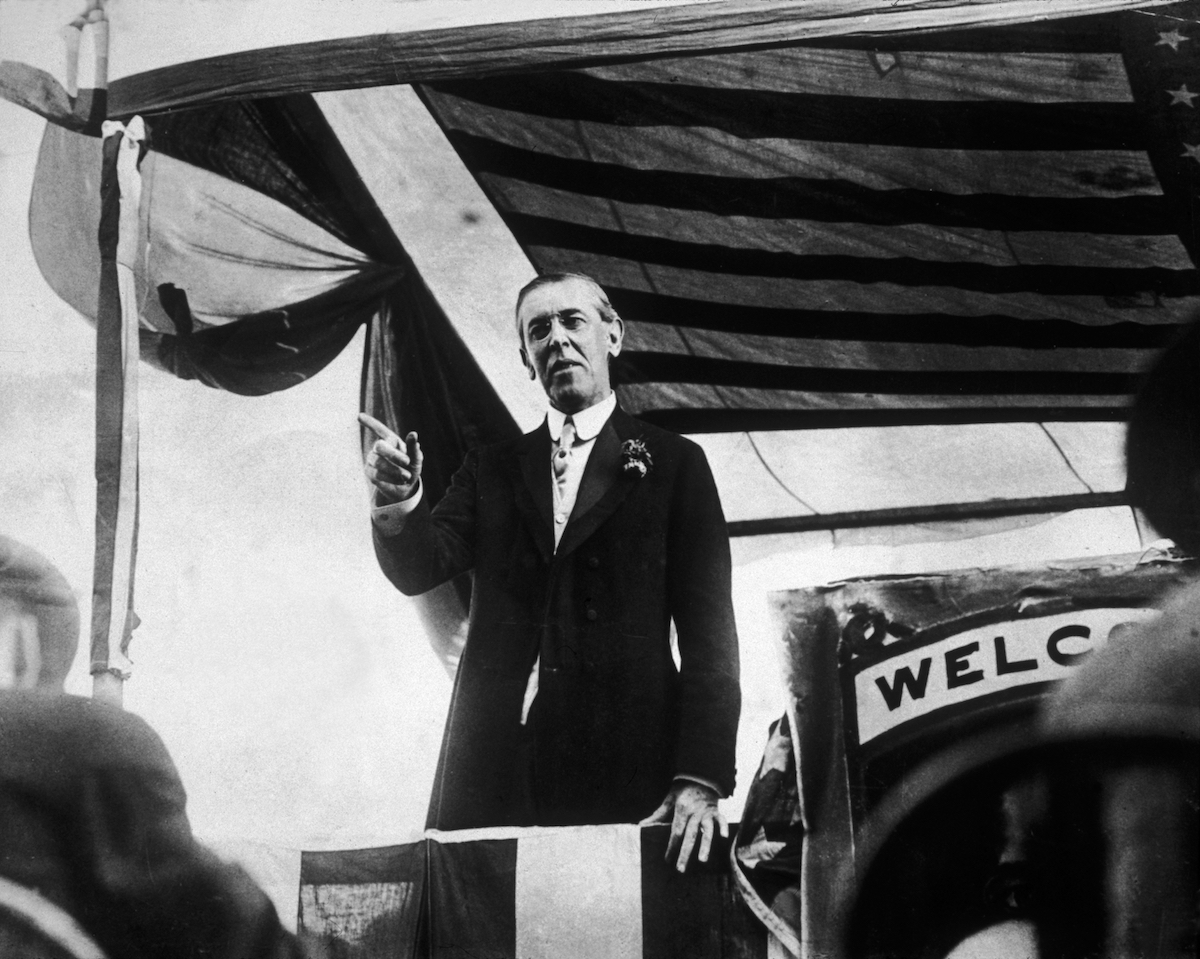
iqsafe.info – Woodrow Wilson, the 28th President of the United States, entered World War I with a vision for a world order based on peace, democracy, and the collective security of nations. By the time the war ended in 1918, Wilson’s idealistic aspirations were reflected in his Fourteen Points, a set of proposals that sought to create a fair and lasting peace after the devastation of the conflict. Wilson’s ambition was to reshape global diplomacy, create institutions that could prevent future wars, and establish a new world order built on mutual cooperation rather than conflict.
However, when Wilson arrived at the Treaty of Versailles negotiations in 1919, he was confronted with the harsh realities of international diplomacy. His vision for a peaceful world, as outlined in the Fourteen Points, faced opposition from European powers, particularly France and Britain, who had suffered tremendous losses during the war and sought revenge against Germany. The outcome was a treaty that largely failed to live up to Wilson’s lofty ideals. Despite his passionate efforts, Wilson’s vision for a just peace was undermined by compromises, national interests, and the refusal of the U.S. Senate to ratify the treaty, which ultimately doomed the League of Nations, the very institution Wilson believed would secure a lasting peace.
In this article, we will explore Wilson’s role in the Treaty of Versailles, the conflict between his ideals and the political realities of the time, the contents of the treaty, and the long-term consequences of the treaty’s failure. We will also examine how Wilson’s experience with the treaty marked a turning point in both his presidency and in the way America engaged with international affairs.
Wilson’s Vision for a New World Order
The Fourteen Points
When World War I ended in November 1918, Wilson’s vision for a post-war world was encapsulated in his Fourteen Points, which he presented to Congress on January 8, 1918. The points outlined Wilson’s hopes for a just peace and included provisions such as:
- Open diplomacy: The call for transparent negotiations between nations and the elimination of secret treaties.
- Freedom of the seas: Ensuring that the seas would remain open to all nations and free from naval blockades.
- Free trade: The removal of trade barriers to encourage global commerce and prosperity.
- Self-determination: The right of nations and peoples to choose their own government and form of political association, particularly in Europe and among colonial territories.
- Disarmament: The reduction of armaments to prevent future wars.
- Creation of the League of Nations: The establishment of an international organization aimed at preserving peace and preventing conflicts through diplomacy and collective security.
Wilson’s idealism and belief in the possibility of a cooperative and peaceful world stood in stark contrast to the nationalist and punitive sentiments that prevailed in Europe after four years of brutal warfare. His aim was to create a global system where nations would settle disputes diplomatically, respect each other’s sovereignty, and work toward mutual benefit. Wilson’s dream of a fair and lasting peace was heavily shaped by his belief that the war had been caused by an international system of imperialism, militarism, and secret alliances, which he hoped to replace with open cooperation and democratic principles.
The Challenge of Allied Interests
However, Wilson was not alone in the negotiations. The Allied Powers, particularly Britain and France, had suffered tremendous human and material losses during the war. Their desire for punitive measures against Germany and the other Central Powers was in direct contrast to Wilson’s vision of a fair peace. France, in particular, had suffered devastating damage to its infrastructure, and Prime Minister Georges Clemenceau was determined to secure reparations and weaken Germany to ensure that it would not be a future threat. Similarly, Britain, under Prime Minister David Lloyd George, had its own set of interests, focusing on securing its empire and maintaining its naval dominance.
These allied leaders were primarily focused on securing reparations from Germany and ensuring its military and economic weakness. While Wilson hoped to avoid harsh punishment for Germany, fearing that it would sow the seeds for future conflict, the European leaders saw retribution as essential for maintaining security and their own national interests. The differing priorities between Wilson and the European powers created a significant rift in the negotiations, one that would ultimately lead to compromises that undermined Wilson’s vision.
The Treaty of Versailles: A Compromise Peace
The Terms of the Treaty
The Treaty of Versailles, signed on June 28, 1919, officially ended World War I and laid out the terms of peace. While Wilson’s Fourteen Points provided the framework for the treaty, many of his ideas were diluted or discarded in favor of the demands of the European powers. Some of the key provisions of the treaty included:
-
Territorial Losses for Germany: Germany was forced to cede significant territory to neighboring countries. The Saar Basin was placed under the control of the League of Nations, and Germany lost its overseas colonies, which were distributed among the Allied powers. The Alsace-Lorraine region was returned to France, and Poland was reestablished as an independent state, with a corridor to the Baltic Sea that separated East Prussia from the rest of Germany.
-
Military Restrictions: Germany’s military was severely limited by the treaty. The size of the German army was reduced to 100,000 troops, conscription was abolished, and the country was prohibited from having an air force, submarines, or tanks. The Rhineland was demilitarized to prevent future aggression against France.
-
Reparations: Germany was held responsible for causing the war and was required to pay reparations to the Allied powers. While the exact amount was not specified in the treaty, it was later determined that Germany owed the Allies over 132 billion gold marks in reparations, a sum that put enormous economic strain on the country.
-
The League of Nations: Wilson’s dream of a League of Nations was enshrined in the treaty. The League was intended to be an international organization that would facilitate diplomacy, promote collective security, and prevent future wars. Wilson believed that the League would be the centerpiece of the new world order, but it was significantly weakened by compromises and the lack of full participation from major powers.
Despite the inclusion of the League of Nations, many aspects of the Treaty of Versailles contradicted Wilson’s Fourteen Points. Self-determination for various ethnic groups, one of Wilson’s key principles, was violated in several instances. For example, while Wilson advocated for the independence of countries like Poland, many regions in the Ottoman Empire were divided among the victors without regard for the desires of local populations.
Wilson’s Disappointment and Opposition to the Treaty
Wilson entered the Treaty of Versailles negotiations with high hopes for creating a just and lasting peace, but as the treaty took shape, he found himself increasingly sidelined by the more powerful European leaders. While Wilson had succeeded in securing the League of Nations as part of the treaty, he had been forced to concede on many of his other points, particularly in relation to Germany.
Wilson was deeply disappointed by the terms of the treaty. Although he had pushed for a more lenient peace with Germany, he found that the treaty was punitive and did not fully align with his vision of a fair peace. He wrote to his wife, Ellen, that the treaty was a “mutilated peace,” reflecting his frustration with the compromises that had been made at the expense of his ideals.
Despite his reservations, Wilson was determined to secure the treaty’s ratification in the United States and push for the creation of the League of Nations. He returned to the U.S. after the signing of the treaty, eager to gain Senate approval for the U.S. to join the League and play a central role in shaping the post-war order.
The Senate Rejection and the End of Wilson’s Dream
The Battle for the League of Nations
Wilson’s greatest challenge in securing the treaty’s legacy came when it was presented to the U.S. Senate for ratification. Many senators, particularly Republicans led by Henry Cabot Lodge, opposed the treaty, primarily because of the League of Nations. These opponents argued that joining the League would entangle the U.S. in international conflicts and compromise the nation’s sovereignty. Isolationists in the Senate feared that the collective security arrangements in the League’s charter could potentially force the U.S. to become involved in European wars.
Wilson, who was deeply committed to the idea of the League, embarked on a nationwide campaign to rally public support for the treaty. However, his efforts were undermined by his deteriorating health and the growing political opposition. In a dramatic gesture, Wilson refused to compromise on the treaty and, instead, continued to push for the Senate to ratify it as it was.
The Senate ultimately rejected the Treaty of Versailles in November 1919, and again in March 1920, ensuring that the U.S. would not join the League of Nations. Wilson’s inability to secure U.S. participation in the League marked a significant failure for his vision of global peace and diplomacy. The League was left to function without the involvement of the world’s most powerful nation, and the treaty itself was a shadow of the peace Wilson had hoped to create.
The Legacy of the Treaty of Versailles
The Treaty of Versailles was a mixed legacy for Wilson. While it succeeded in establishing the League of Nations, Wilson’s other goals — such as self-determination for all nations and the creation of a just, non-punitive peace — were largely sidelined. The punitive provisions placed on Germany contributed to economic hardship, resentment, and political instability in the country, which would eventually help pave the way for World War II.
Wilson’s intellectual vision for a peaceful world order was dashed by the realities of international politics, and his failure to secure U.S. participation in the League of Nations diminished the treaty’s potential effectiveness. Despite this, Wilson’s commitment to the idea of a cooperative, multilateral world order continues to resonate today, and his role in founding the League of Nations laid the groundwork for the United Nations following World War II.
In conclusion, the Treaty of Versailles represented the clash between Wilson’s idealism and the political realities of post-war Europe. While the treaty included provisions that reflected his vision for global cooperation and peace, it was ultimately a compromise that failed to secure a lasting and just peace. Wilson’s dream of a world governed by democracy, diplomacy, and collective security may have been unfulfilled, but his legacy in shaping the international system remains an enduring testament to the power of ideals in the pursuit of global peace.