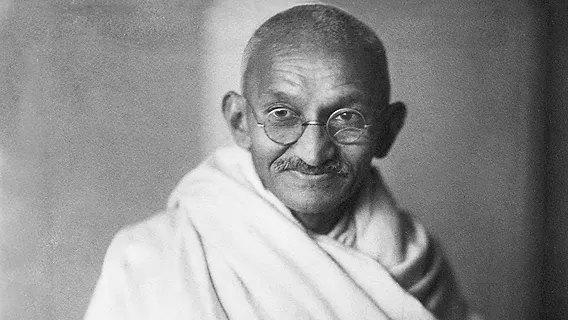
iqsafe.info – Mahatma Gandhi, a leader of extraordinary vision and moral clarity, is one of the most influential figures in modern history. Known as the “Father of the Nation” in India, his philosophy of nonviolence (ahimsa) and civil disobedience led India to independence from British rule. His influence, not only in India but across the world, continues to inspire movements for peace, justice, and human rights. This article explores the life, philosophy, struggle for independence, and lasting legacy of Mahatma Gandhi.
Early Life and Education
Mahatma Gandhi was born on October 2, 1869, in Porbandar, a coastal town in the present-day state of Gujarat, India. He was born into a well-to-do family with a strong tradition of public service, and his early years were shaped by the values of honesty, integrity, and respect for all people.
Family Background and Early Influences
Gandhi’s father, Karamchand Gandhi, was the diwan (chief minister) of Porbandar, and his mother, Putlibai, was a deeply religious woman. Gandhi’s upbringing was influenced by his mother’s strong faith and simplicity, which shaped his moral and spiritual outlook. His family followed Hindu traditions, and Gandhi was deeply influenced by the principles of nonviolence, vegetarianism, and truth from an early age.
Education in England and Encounter with Racial Discrimination
At the age of 18, Gandhi traveled to London to study law at University College London. His time in England exposed him to a broader range of ideas, including the philosophy of nonviolence and the works of Christian thinkers such as Leo Tolstoy and John Ruskin. It was also during this period that Gandhi faced racial discrimination, an experience that would profoundly shape his later activism.
After completing his studies in 1891, Gandhi returned to India to practice law. However, his legal career in India proved unremarkable. He soon accepted an offer to represent an Indian company in South Africa, which marked the beginning of his political and social awakening.
Gandhi in South Africa: The Birth of a Revolutionary
Gandhi’s years in South Africa, from 1893 to 1914, were pivotal in shaping his philosophy of resistance. Although initially planning to stay for only one year, he spent over two decades in South Africa, during which he witnessed and fought against the harsh racial discrimination and oppression faced by the Indian community.
The Fight for Indian Rights in South Africa
In 1893, Gandhi traveled to South Africa to work as a legal advisor for the Indian community. He was appalled by the widespread discrimination against Indians, who were denied basic rights such as voting, education, and access to public services. Gandhi soon became a leading figure in the fight for the rights of Indians in South Africa.
Gandhi’s first significant experience with racial injustice occurred when he was thrown off a train for refusing to move to a segregated carriage, even though he had a valid first-class ticket. This incident sparked his commitment to fighting injustice, and he began organizing protests and campaigns against discriminatory laws, such as the poll tax and the registration of Indians.
The Concept of Satyagraha
It was during his time in South Africa that Gandhi developed the concept of Satyagraha, which translates to “truth force” or “soul force.” This philosophy of nonviolent resistance was based on the belief that individuals could stand up for their rights without resorting to violence. Gandhi believed that nonviolent resistance had the power to transform both the oppressor and the oppressed.
Gandhi’s campaigns in South Africa were marked by nonviolent protests, boycotts, and civil disobedience. His efforts culminated in the victory of the Indian community, with the South African government agreeing to amend discriminatory laws and grant Indian citizens greater rights.
Return to India and the Fight for Independence
After his success in South Africa, Gandhi returned to India in 1915, determined to apply his philosophy of nonviolence and civil disobedience to the struggle for Indian independence from British colonial rule. His arrival marked the beginning of a new phase in India’s fight for freedom, and he quickly became a central figure in the Indian National Congress (INC), the leading political party advocating for independence.
The Non-Cooperation Movement
In 1919, after the British government passed the Rowlatt Act, which allowed for the arrest of Indians without trial, Gandhi launched the Non-Cooperation Movement. The movement called for Indians to boycott British goods, refuse to attend British schools, and resign from government jobs. Gandhi believed that nonviolent resistance, such as strikes and protests, would weaken British control over India and force the British to grant independence.
The movement gained widespread support across India, with millions of Indians participating in boycotts, protests, and strikes. However, the movement was suspended in 1922 after the Chauri Chaura incident, in which a mob of protesters killed 22 policemen. Gandhi, believing that the movement had turned violent, called off the protests and was arrested by the British authorities.
The Salt March and Civil Disobedience
One of Gandhi’s most famous acts of civil disobedience occurred in 1930, when he led the Salt March to protest the British monopoly on salt production. The British government had imposed a tax on salt, and Gandhi saw this as an unjust tax that exploited the poor. Gandhi and his followers walked over 240 miles to the coastal town of Dandi, where they collected salt from the sea in defiance of British laws.
The Salt March was a turning point in the Indian independence movement, as it galvanized Indians across the country and attracted international attention. Gandhi’s act of defiance against British colonial authority became a symbol of India’s struggle for freedom.
The Quit India Movement and Final Push for Independence
In 1942, Gandhi launched the Quit India Movement, calling for the immediate withdrawal of British forces from India. The movement was a mass civil disobedience campaign, and despite widespread protests, the British government responded by arresting thousands of Indian leaders, including Gandhi. Although the movement was eventually crushed by British authorities, it marked a decisive moment in India’s fight for independence.
By this time, the British Empire was weakened by the pressures of World War II, and the Indian independence movement had gained significant momentum. In 1947, after years of struggle, India finally gained independence from British rule on August 15, 1947.
Gandhi’s Philosophy of Nonviolence and its Global Impact
Mahatma Gandhi’s philosophy of nonviolence, or ahimsa, became the cornerstone of his political and social activism. His belief that nonviolence was the most powerful weapon for social and political change resonated far beyond India and inspired many leaders around the world.
Influence on Civil Rights Movements
Gandhi’s commitment to nonviolence influenced many leaders of civil rights movements across the world. Perhaps the most notable example is Martin Luther King Jr., the American civil rights leader who was deeply inspired by Gandhi’s philosophy. King adopted nonviolent resistance as a core principle of his movement, leading to the successful struggle for racial equality in the United States.
Similarly, figures like Nelson Mandela in South Africa and Cesar Chavez in the United States drew inspiration from Gandhi’s teachings in their struggles for justice and equality.
The Concept of Truth and Self-Discipline
Gandhi’s life was also guided by the principle of truth, or Satya. He believed that truth was not merely an intellectual concept but a way of life. Gandhi’s commitment to truth involved both personal discipline and public action. He was known for his simplicity, self-reliance, and adherence to moral principles, including his practice of fasting as a means of self-purification and protest.
Legacy of Gandhi’s Nonviolence in Modern Times
Gandhi’s philosophy of nonviolence continues to inspire peace and social justice movements around the world. His emphasis on nonviolent resistance as a means to achieve social change has been adopted by numerous organizations and activists. His legacy serves as a reminder that peaceful methods can be a powerful force for social and political transformation.
Conclusion
Mahatma Gandhi’s contributions to the Indian independence movement and to global peace and justice are immeasurable. His commitment to nonviolence, truth, and self-discipline transformed the course of history and inspired generations of leaders and activists. Gandhi’s philosophy of nonviolence continues to resonate today as a beacon of hope for a more just, peaceful world. His legacy as the Father of the Nation in India and as a champion of civil rights and human dignity remains an enduring symbol of the power of nonviolent resistance in the struggle for justice and freedom.