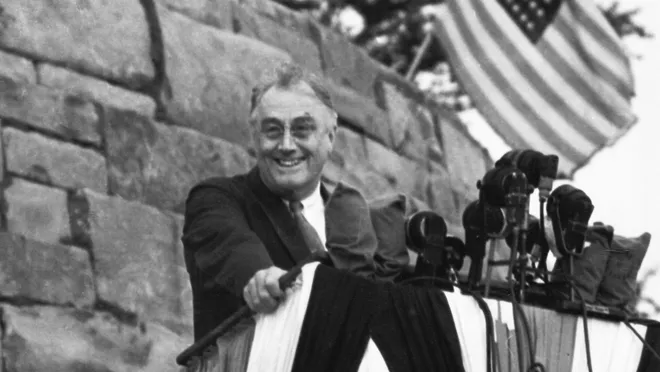
iqsafe.info – Franklin Delano Roosevelt, the 32nd president of the United States, stands as one of the most iconic and influential leaders in American history. Serving four terms from 1933 to 1945, Roosevelt led the nation through two of its gravest crises: the Great Depression and World War II. His leadership, vision, and ability to rally the American people during these times of unprecedented turmoil cemented his legacy as a president who steered America through darkness and laid the foundation for a more prosperous, secure, and equitable future.
This article explores Roosevelt’s leadership during the Great Depression and World War II, examining how he navigated these crises, reshaped the role of government, and forever altered the political, economic, and social landscape of the United States.
Early Life and Political Rise
A Prominent Upbringing
Franklin Delano Roosevelt was born on January 30, 1882, into a wealthy and influential family in Hyde Park, New York. He grew up in a privileged environment, receiving private education and eventually attending Harvard University. Roosevelt’s family background instilled in him a sense of duty and service, but it was his distant cousin, Theodore Roosevelt—26th president of the United States—who served as a key inspiration for his political ambitions.
In 1905, Franklin married Eleanor Roosevelt, Theodore’s niece, beginning a lifelong partnership that would greatly influence his political career and shape his progressive values.
Political Beginnings
Roosevelt entered politics in 1910 when he was elected to the New York State Senate as a Democrat, a rare feat in a predominantly Republican district. His charisma and political skill quickly propelled him into the national spotlight. In 1913, President Woodrow Wilson appointed him Assistant Secretary of the Navy, a position he held during World War I. Roosevelt’s work in the Navy gave him valuable experience in leadership and administration, and he emerged from the war as a rising star in the Democratic Party.
In 1920, Roosevelt ran for vice president on the Democratic ticket but lost. Shortly after, he was struck by a personal tragedy that would shape the rest of his life—he contracted polio, leaving him partially paralyzed. However, Roosevelt’s determination and resilience never wavered. Through years of physical therapy and with the support of his wife, Eleanor, he overcame his physical limitations and returned to politics stronger than ever.
The Great Depression and the New Deal
The Stock Market Crash and Economic Collapse
By the time Roosevelt was elected president in 1932, the United States was in the depths of the Great Depression, the most severe economic crisis in its history. The stock market crash of 1929 had triggered a massive collapse of the banking system, widespread unemployment, and economic despair. By 1932, the U.S. unemployment rate had soared to 25%, and millions of Americans were homeless, hungry, and desperate.
Roosevelt ran for president on a platform of optimism and hope, promising a “New Deal” for the American people. His message resonated with a nation longing for relief, and he won the 1932 election in a landslide, defeating incumbent President Herbert Hoover.
The First Hundred Days: Immediate Action
Upon taking office in March 1933, Roosevelt wasted no time. In his first Hundred Days, he introduced an unprecedented wave of legislation aimed at stabilizing the economy, providing immediate relief to struggling Americans, and laying the groundwork for long-term recovery. Roosevelt’s first priority was to restore confidence in the banking system, which was on the verge of collapse. He declared a national bank holiday, temporarily closing all banks while the government worked to secure and reorganize them. This action, coupled with the Emergency Banking Act, helped restore public trust and stem the tide of bank failures.
The Hundred Days also saw the creation of numerous programs and agencies designed to address the immediate needs of the American people. The Civilian Conservation Corps (CCC) put unemployed young men to work on environmental conservation projects, while the Public Works Administration (PWA) and Civil Works Administration (CWA) provided jobs building infrastructure such as roads, bridges, and schools. Roosevelt’s administration also established the Agricultural Adjustment Administration (AAA) to help farmers by stabilizing crop prices and reducing surpluses.
The cornerstone of Roosevelt’s early New Deal efforts was the National Industrial Recovery Act (NIRA), which aimed to boost industrial production and improve labor conditions by encouraging cooperation between government, business, and labor. Although the NIRA was later ruled unconstitutional, it laid the groundwork for future labor reforms.
The New Deal: Expanding the Role of Government
Roosevelt’s New Deal was more than a collection of emergency programs; it was a fundamental rethinking of the relationship between the federal government and the American people. Under Roosevelt, the government took on a much more active role in regulating the economy, protecting workers, and providing a social safety net for citizens.
One of the most significant New Deal programs was the Social Security Act of 1935, which established the nation’s first federal retirement system, providing pensions for the elderly and unemployment insurance for those who lost their jobs. The Social Security Act marked a major expansion of the federal government’s role in ensuring economic security for Americans and remains a cornerstone of the American welfare state to this day.
Other key New Deal initiatives included the Wagner Act, which strengthened labor unions by guaranteeing workers the right to collectively bargain, and the creation of the Securities and Exchange Commission (SEC) to regulate the stock market and protect investors from fraud.
While the New Deal did not fully end the Great Depression—economic recovery would not come until the outbreak of World War II—it succeeded in providing relief to millions of Americans, stabilizing key sectors of the economy, and restoring hope to a nation in crisis. Roosevelt’s leadership during this period fundamentally reshaped American society and the role of government in addressing social and economic challenges.
World War II: Leading America on the Global Stage
The Road to War
As the 1930s progressed, Roosevelt turned his attention to the growing threat of war in Europe and Asia. By 1939, Nazi Germany, led by Adolf Hitler, had launched a series of aggressive territorial expansions, invading Poland and triggering the outbreak of World War II. In Asia, Japan was pursuing its imperial ambitions, expanding into China and Southeast Asia.
Though Roosevelt recognized the threat posed by fascist regimes, the United States remained deeply isolationist in the years leading up to the war. Many Americans were reluctant to become involved in another overseas conflict, especially in the aftermath of World War I. Despite this sentiment, Roosevelt worked behind the scenes to prepare the United States for potential involvement. He increased military spending, expanded the Navy, and sought ways to support Allied nations fighting against the Axis powers, particularly the United Kingdom.
In 1940, Roosevelt made the unprecedented decision to run for a third term as president, arguing that the nation needed continuity of leadership in a time of global crisis. He won re-election and soon after ramped up support for the Allies through measures like the Lend-Lease Act, which allowed the U.S. to provide military aid to countries fighting against Germany, Italy, and Japan.
Pearl Harbor and America’s Entry into the War
The United States officially entered World War II on December 7, 1941, when Japan launched a surprise attack on the U.S. naval base at Pearl Harbor, Hawaii. The attack killed over 2,400 Americans and destroyed much of the Pacific Fleet. The next day, Roosevelt delivered his famous “Day of Infamy” speech to Congress, and the United States declared war on Japan. Shortly thereafter, Germany and Italy declared war on the United States, pulling the nation into the global conflict.
Roosevelt’s leadership during the war was critical in guiding the nation through one of its most challenging periods. He oversaw the mobilization of the American economy for war production, transforming factories to produce weapons, planes, ships, and other materials necessary for the war effort. Under his administration, the United States became the “Arsenal of Democracy,” supplying not only its own military but also the Allies with the tools needed to defeat the Axis powers.
Leadership as Commander-in-Chief
As Commander-in-Chief, Roosevelt worked closely with Allied leaders, including British Prime Minister Winston Churchill and Soviet Premier Joseph Stalin, to develop military strategy and coordinate efforts to defeat Nazi Germany and Imperial Japan. Together, they forged the Grand Alliance, a coalition of nations committed to the defeat of the Axis powers.
Roosevelt played a key role in planning the D-Day invasion of Normandy, which marked the beginning of the end for Nazi Germany. He also supported the development of the Manhattan Project, the top-secret program that would eventually lead to the creation of the atomic bomb.
Throughout the war, Roosevelt skillfully balanced military strategy with diplomacy, ensuring that the Allies remained united in their efforts despite differing political ideologies and post-war ambitions.
Roosevelt’s Legacy
Transforming the Role of Government
Franklin D. Roosevelt’s presidency fundamentally transformed the role of the federal government in American life. Through his New Deal programs, he expanded the government’s responsibilities in regulating the economy, providing social welfare, and protecting workers’ rights. These changes laid the foundation for the modern welfare state and established the principle that the government has a responsibility to ensure the well-being of its citizens.
Shaping the Post-War World
As the war drew to a close, Roosevelt turned his attention to shaping the post-war world. He was instrumental in the creation of the United Nations, an international organization aimed at promoting peace, security, and cooperation among nations. Roosevelt envisioned a world where nations would work together to prevent future conflicts and protect human rights. Although he did not live to see the end of the war, his vision for a more just and peaceful world endured.
Enduring Influence
Franklin D. Roosevelt passed away on April 12, 1945, just months before the Allied victory in World War II. His death marked the end of an era, but his legacy continues to shape American politics and society. His leadership during the Great Depression and World War II left an indelible mark on the United States, and his belief in the power of government to improve people’s lives remains a guiding principle for many to this day.
Roosevelt’s ability to navigate two of the greatest crises in American history—the Great Depression and World War II—cemented his place as one of the greatest presidents in U.S. history. He remains a symbol of resilience, leadership, and the enduring capacity of the American people to overcome adversity.
In conclusion, Franklin D. Roosevelt’s presidency was defined by crisis, but it was also defined by his vision for a better future. He led the nation through economic hardship and global conflict, emerging as a transformative figure who fundamentally reshaped American society and government. Roosevelt’s leadership, ideals, and legacy continue to inspire and resonate, not just in the United States but around the world.
