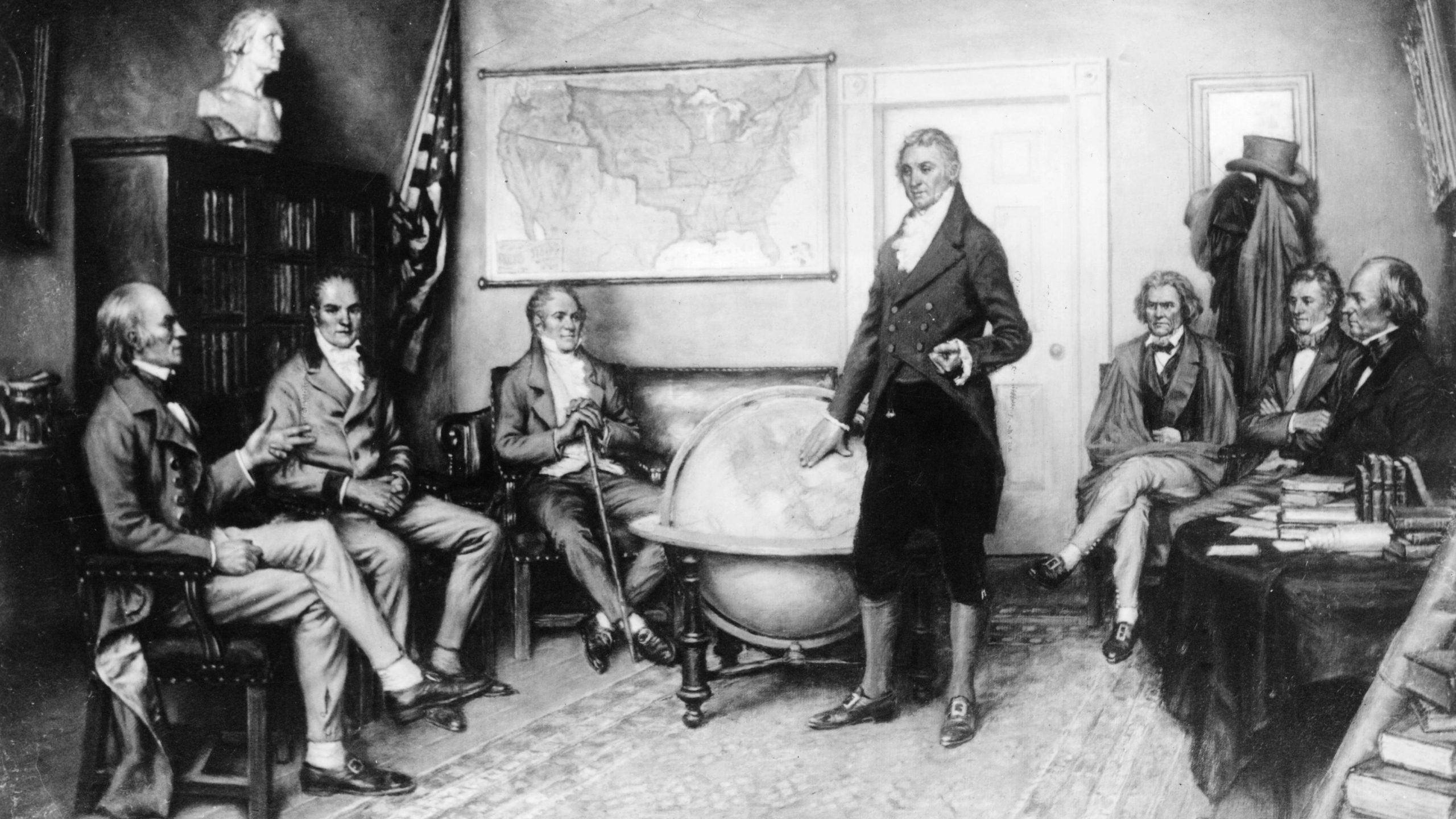
iqsafe.info – James Monroe, the fifth president of the United States, served from 1817 to 1825, a time of significant change and growth for the young nation. His presidency, often referred to as the “Era of Good Feelings,” is remembered for its relative political harmony, national expansion, and growing sense of American identity. However, Monroe’s time in office was also fraught with challenges, from dealing with the aftermath of the War of 1812 to managing the complex issue of slavery and sectionalism. Despite these obstacles, Monroe’s presidency left an indelible mark on the nation’s development, particularly in terms of foreign policy and territorial expansion.
The “Era of Good Feelings” and National Unity
The End of the Federalist Party
Monroe’s presidency occurred during a time when the United States had experienced intense political divisions, particularly between the Federalists and the Democratic-Republicans. However, by the time Monroe took office in 1817, the Federalist Party had essentially dissolved. The War of 1812 had weakened the Federalists, who had opposed the war and were perceived as unpatriotic. The Democratic-Republicans, the party Monroe belonged to, became the dominant political force in the country.
With the Federalists’ decline, there was a temporary reduction in party political strife, giving rise to what is often called the “Era of Good Feelings.” This was a time when Monroe enjoyed widespread popularity, and national unity seemed to prevail. His presidency was marked by a spirit of cooperation rather than bitter political rivalry. Despite these harmonious conditions, Monroe’s presidency was not without challenges that would test his leadership and shape his legacy.
Economic Recovery After the War of 1812
The War of 1812 had left the United States economically weakened, with disrupted trade and a national debt that had ballooned during the conflict. Monroe’s administration sought to address the economic issues that arose during the war’s aftermath. In response to the economic hardship, Monroe supported internal improvements, such as building roads and canals, that would facilitate trade and communication across the country.
Monroe’s administration also supported the creation of a Second Bank of the United States in 1816. The First Bank, which had expired in 1811, was an institution that helped stabilize the national economy, but its absence after its expiration had contributed to inflation and financial instability. The Second Bank helped regulate the currency, control inflation, and facilitate the country’s financial system. Despite opposition from some quarters, Monroe’s backing of this institution reflected his belief that economic stability was essential for the future of the nation.
The Panic of 1819
While Monroe’s presidency began with economic optimism, it faced significant setbacks as well. In 1819, the United States experienced the first major financial panic since its independence. Known as the Panic of 1819, this economic downturn was caused by a combination of speculative land purchases, falling cotton prices, and an overextension of credit. The panic led to widespread unemployment, bank failures, and a sharp decline in property values.
The effects of the panic were felt most acutely in the Western territories, where settlers had relied on easy credit to purchase land. The financial crisis exacerbated tensions between the agricultural South and the more industrializing North. The panic exposed weaknesses in the banking system and the overall economy, and it took several years for the country to fully recover.
Territorial Expansion and the Monroe Doctrine
The Monroe Doctrine: Defining U.S. Foreign Policy
One of the defining achievements of Monroe’s presidency was the articulation of the Monroe Doctrine in 1823. The doctrine was a bold statement of U.S. foreign policy that declared the Western Hemisphere closed to European colonization. Monroe declared that the United States would not tolerate European interference in the affairs of nations in the Americas and that any such attempts would be viewed as acts of aggression. In return, the U.S. would not interfere in European affairs or engage in European wars.
The Monroe Doctrine was born out of a desire to protect the newly independent nations of Latin America, many of which were former Spanish colonies. Monroe and his Secretary of State, John Quincy Adams, were concerned that European powers, particularly Spain and Russia, might attempt to reassert control over these territories. In particular, Monroe was worried about the potential for European intervention in Latin America and the Caribbean, which might undermine American security.
The doctrine, while not immediately backed by military force, set the foundation for U.S. foreign policy in the Western Hemisphere for decades. It became a cornerstone of U.S. diplomacy, particularly in the 19th and early 20th centuries. Though Monroe’s warning was not universally accepted by European powers, it demonstrated the United States’ growing confidence in asserting its dominance in the Western Hemisphere.
The Acquisition of Florida
Another major achievement of Monroe’s presidency was the acquisition of Florida from Spain. Spain had long struggled to maintain control over Florida, which had become a haven for runaway slaves and hostile Native American groups. The United States had been pressing Spain to cede Florida, as it was seen as a strategic area that would secure the U.S. southern border.
In 1819, Monroe and his Secretary of State, John Quincy Adams, negotiated the Adams-Onís Treaty with Spain. Under the treaty, Spain ceded Florida to the United States and agreed to a boundary line between U.S. and Spanish territories in North America. The treaty not only secured U.S. territorial claims in the region but also eliminated a source of potential conflict with Spain, whose influence in the Americas was rapidly waning.
The acquisition of Florida also provided the United States with greater control over the southeastern region, contributing to the nation’s growing sense of territorial and geopolitical power.
Slavery and Sectionalism: The Missouri Compromise
The Missouri Crisis and the Missouri Compromise
Despite the relative unity of Monroe’s presidency, the issue of slavery began to deepen the sectional divides within the United States. The most prominent example of this divide during Monroe’s time in office was the debate over Missouri’s admission to the Union.
In 1819, Missouri applied for statehood, and its request sparked a heated debate over whether it would enter as a free state or a slave state. The admission of Missouri had the potential to upset the delicate balance between free and slave states in Congress. The question of whether slavery would be allowed to expand into new territories became a central issue, and it revealed the growing tensions between the North and South.
To resolve the crisis, Monroe’s administration supported the Missouri Compromise of 1820, brokered by Speaker of the House Henry Clay. The compromise allowed Missouri to enter the Union as a slave state while admitting Maine as a free state, thus maintaining the balance in the Senate. It also established the 36°30′ line, which prohibited slavery north of that line in the Louisiana Territory (except in Missouri). The Missouri Compromise temporarily defused the conflict, but it highlighted the deepening sectional divide over slavery.
The Growing Divide Between North and South
While the Missouri Compromise temporarily settled the issue of slavery’s expansion, it did little to address the underlying tensions between the North and South. The issue of slavery would continue to dominate U.S. politics in the coming decades, with new territories and states continuing to raise questions about the institution’s future. Monroe’s presidency, therefore, marked the beginning of a period in which slavery would become an increasingly divisive issue, leading ultimately to the Civil War.
Monroe’s Final Years in Office
Re-election and the “Era of Good Feelings”
Monroe was re-elected president in 1820, receiving virtually all of the electoral votes except for one, which was cast in favor of John Quincy Adams. The landslide victory reflected the widespread support Monroe enjoyed across the country, and his second term was marked by relative peace and stability.
The “Era of Good Feelings” continued under Monroe’s second term, but beneath the surface, the growing sectional tensions over slavery and economic instability—exemplified by the Panic of 1819—were beginning to take root. Although Monroe was able to maintain a sense of national unity, the period of goodwill was ultimately short-lived, giving way to more intense political conflict in the 1820s and beyond.
The End of Monroe’s Presidency
By the time Monroe left office in 1825, the United States had emerged as a more unified and powerful nation, but it was also a nation on the brink of major internal conflict. Monroe’s leadership during a time of relative peace and expansion set the stage for future American presidents to continue the work of territorial growth and international influence.
After leaving office, Monroe retired to his estate in Virginia, where he lived quietly until his death in 1831. His final years were marked by financial struggles, and he was largely forgotten by the public during his later life. Nonetheless, Monroe’s contributions to American foreign policy and territorial expansion remain a key part of his legacy.
Conclusion
James Monroe’s presidency was a time of both challenges and triumphs. He navigated the complexities of foreign diplomacy, including the Monroe Doctrine and the acquisition of Florida, while also dealing with growing sectional tensions over slavery. His efforts to promote national unity, economic stability, and territorial expansion helped to shape the future of the United States, but the issues he faced also highlighted the deepening divisions that would eventually lead to the Civil War.
Monroe’s legacy is that of a president who helped guide the country through a critical time in its history. His leadership in securing American sovereignty in the Western Hemisphere, his efforts to address economic instability, and his handling of the slavery question continue to influence the trajectory of the nation. Though his presidency was not without its challenges, Monroe’s role in American history remains an essential part of the story of the United States’ development as a young and ambitious nation.